The ISP Industry Is Changing Fast in 2026
There's a certain kind of ISP operator who watches the big industry news from the sidelines and assumes none of it applies to them. The fiber rollouts, the AI announcements, the consolidation headlines — that's for the big players, right?
Maybe. But the trends reshaping the ISP industry at the top don't stay at the top. They filter down. And in 2026, they're filtering down faster than most small and mid-size operators realize.
If you're running an ISP right now, here's what's actually happening in the industry — and what it means for how you should be running your operation.
Fiber Just Had Its Biggest Year Ever. And It's Not Slowing Down.
In 2025, the fiber broadband industry broke records. The fiber industry set a new record for growth, hitting 11.8 million homes passed — and total fiber passings have now reached nearly 100 million homes in the United States alone. Bbcmag
That's not just an American story. In emerging economies across Asia, Africa, and Latin America, fiber networks are increasingly seen as a catalyst for rapid socio-economic development, with governments offering incentives and subsidies to attract private-sector investment. PPC Broadband
What this means on the ground: more competition. Areas with only one fiber provider are increasingly becoming targets for a second provider to overbuild. The comfortable position of being the only internet option in your area is eroding. Clients who used to have no choice now do. Corning
The ISPs that survive this shift aren't the ones with the most infrastructure. They're the ones whose operations are tight enough to compete on service quality, response time, and client experience — not just price.
AI Is Coming Into ISP Operations — Quietly, Then All at Once
You've heard about AI for two years. Most ISPs haven't felt it yet. That's changing in 2026.
Embedding AI throughout network operations is expected to be a key differentiator for service providers in 2026 and beyond. Specifically, AI is enhancing customer support through smarter tools that improve satisfaction and reduce churn. NCTANCTA
In broadband specifically, AI is expected to streamline OSS/BSS processes and engineering design, while a new generation of AI tools tailored for broadband is beginning to emerge — spanning automation, analytics, and customer support. Isp
Here's the part that matters for smaller operators: you don't need to build any of this yourself. The AI that's coming into ISP management isn't research-grade software that requires a data science team. It's built into the platforms you use — in billing systems, in support tools, in dashboards that surface problems before your clients call you about them.
The question isn't whether AI will affect how you run your ISP. It will. The question is whether your current tools are positioned to take advantage of it — or whether you're still on spreadsheets when everyone else has moved on.
Subscriber Expectations Are Rising. Faster Than You Think.
This is the shift that hits closest to home for most operators.
This year's data reveals significant momentum in subscriber consumption patterns — daily download usage per subscriber increased year-over-year, with fiber subscribers seeing a bigger jump than fixed wireless counterparts. Fiberbroadband
More usage means more support requests. More questions about billing. More complaints when service dips. More clients who know exactly what good service looks like because they've experienced it elsewhere.
Customers increasingly expect real choice, and they are vocal when that choice still comes with confusion, hidden fees, or disruption. Cartesian
What this looks like in practice: clients don't want to call you. They want to check their invoice online, see their connection status, and get a ticket update without chasing you on WhatsApp. They want things to just work — and when something doesn't, they want a fast, professional response.
ISPs that still manage client communication manually — through phone calls, personal messages, and scattered spreadsheet records — are going to feel this pressure more and more. The bar for what "good service" looks like is being set by the operators who've automated those touchpoints.
The Consolidation Wave Is Real — But Small ISPs Have an Advantage
One of the major trends of 2025 was the accelerating wave of ISP mergers and acquisitions. Larger operators are absorbing smaller ones. Capital is concentrating. ETI
This sounds threatening. But there's another side to it.
Some industry observers warn that consolidation can dilute innovation and reduce the agility that smaller ISPs bring to the market. And that's real. A small, well-run ISP can move faster than a regional giant. They can know their clients personally, respond quickly, and adapt to local market needs in ways that a consolidated operator with 50,000 subscribers simply cannot. ETI
The advantage disappears the moment a small ISP's operations fall behind. When billing is chaotic, when support is untracked, when there's no visibility into what's actually happening in the business — the size advantage becomes a liability. You lose the personal touch without gaining any of the efficiency.
The small ISPs that will be standing in 5 years aren't the ones trying to out-spend the big players. They're the ones who've made their operations as clean and tight as an operator ten times their size.
What "Digital Transformation" Actually Means for an ISP Your Size
Whether the topic is monetization, consolidation, AI, or operations, success increasingly depends on digital transformation — and the ability to integrate tools and platforms is becoming a major differentiator between high-performing providers and those that struggle to scale. ETI
That phrase — digital transformation — gets thrown around a lot. For a small or mid-size ISP, it doesn't mean building a custom platform or hiring a software team. It means replacing the manual, error-prone parts of your operation with systems that run on their own.
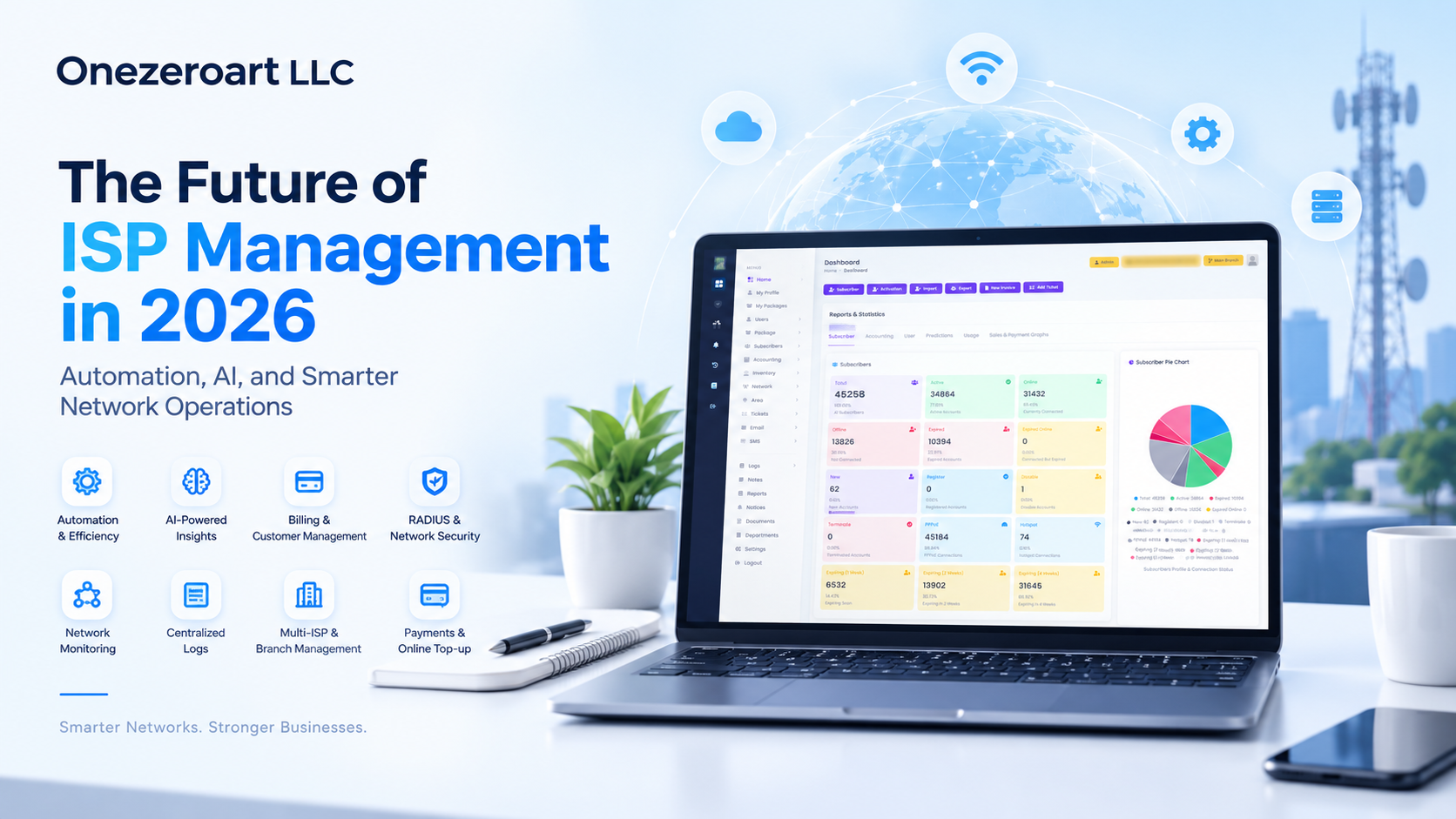
Automated billing that sends invoices and renewals without your involvement. A client portal where subscribers can view their history and pay online. A ticketing system that logs every support request and tracks it to resolution. A dashboard that gives you an accurate picture of your active clients, overdue accounts, and open issues at any moment.
That's digital transformation at the ISP level. It's not glamorous. But the operators who've done it are the ones who can handle 500 clients with a team of 4, respond to support requests in under an hour, and actually know what their revenue looks like on any given day.
ZalUltra Was Built for Exactly This Moment
The trends we've covered — rising competition, growing subscriber expectations, the pressure to modernize — are all pointing to the same thing: ISPs need a system that handles operations properly.
ZalUltra ISP CRM is built for small and mid-size internet service providers who want to run a professional operation without building one from scratch.
Billing is automated. Client profiles are complete — invoices, tickets, notes, login history, email logs, all in one place. Support runs through a structured ticketing system, not WhatsApp. And the dashboard gives you real-time visibility into your business without having to dig for it.
You don't need to wait for your operation to get chaotic before fixing it. The ISPs that are positioned well for what's coming in 2026 and beyond are the ones who built the right foundation early.
Visit zalcrm.com to see how ZalUltra works — or reach out to our team directly if you want to talk through your specific setup.
ZalUltra is an ISP CRM product by Onezeroart LLC. Built for ISPs that want to run tighter operations and grow with confidence.